While Nepal is predominantly Hindu, it holds a singular place in the history of Buddhism: it is the birthplace of Siddhartha Gautama, the historical Buddha. For Buddhists around the world, Nepal is the ultimate pilgrimage destination.
Buddhism in Nepal is not a single, unified tradition. It is a rich tapestry that includes Theravada, Mahayana, Vajrayana (Tibetan), and the unique Newar Buddhism, which blends Buddhist and Hindu practices.
Lumbini: The Birthplace of the Buddha
Located in the Terai plains of southern Nepal, Lumbini is one of the four most sacred pilgrimage sites in Buddhism. It is here, in the Lumbini Garden, that Queen Maya Devi is said to have given birth to Siddhartha Gautama around the 6th century BCE.
- Maya Devi Temple: Marks the exact spot of the Buddha’s birth.
- Ashoka Pillar: Erected by the Indian Emperor Ashoka in 249 BCE to commemorate the birthplace. The inscription confirms Lumbini as the Buddha’s birthplace.
- Monastic Zone: A large area where Buddhist countries from around the world (Thailand, Myanmar, China, Germany, etc.) have built their own monasteries.
The Great Stupas of Kathmandu
The Kathmandu Valley is home to two of the most important Buddhist stupas in the world:
Boudhanath Stupa
One of the largest stupas in the world, Boudhanath is the spiritual heart of Tibetan Buddhism in Nepal. Since the 1950s, thousands of Tibetan refugees have settled around Boudhanath, building over 50 monasteries. The stupa is a UNESCO World Heritage Site and a center of pilgrimage for Tibetan Buddhists worldwide.
Swayambhunath Stupa
Perched on a hilltop west of Kathmandu, Swayambhunath (the “Monkey Temple”) is one of the oldest Buddhist sites in the valley. Its iconic white dome and gilded spire, painted with the eyes of the Buddha, are visible from across the city.
Newar Buddhism
The Newar community of the Kathmandu Valley practices a unique form of Buddhism that is deeply intertwined with Hinduism. Newar Buddhism is a form of Vajrayana that emphasizes rituals, esoteric practices, and the worship of a pantheon of deities.
- Bahas and Bahis: Newar Buddhist monasteries are called Bahas or Bahis, which function as both religious centers and community courtyards.
- Priests: Unlike other Buddhist traditions, Newar Buddhism has a caste of hereditary priests called Bajracharyas.
Tibetan Buddhism in the Himalayas
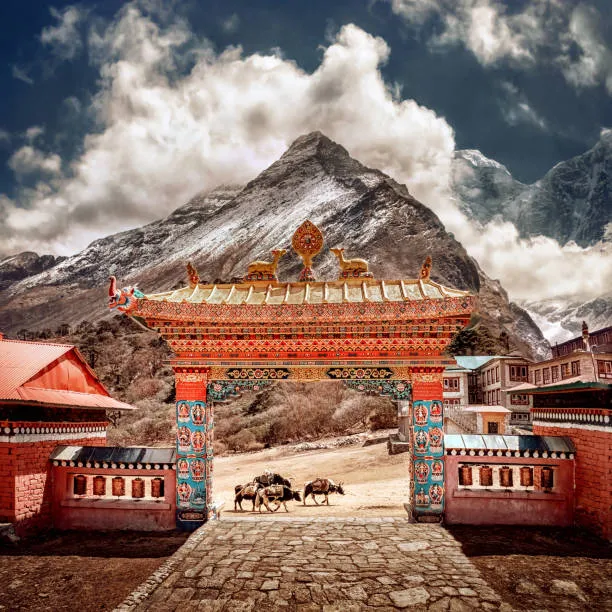
The Sherpa, Tamang, Gurung, and other Himalayan communities practice Tibetan Buddhism. The monasteries (Gompas) of the Everest and Annapurna regions are central to the cultural life of these communities.
- Tengboche Monastery: The most famous monastery in the Everest region, located on the trail to Base Camp.
- Masked Dances: Tibetan Buddhist monasteries perform Cham (masked dances) during festivals like Mani Rimdu and Losar.
Buddhism and Hinduism
Buddhism and Hinduism have coexisted peacefully in Nepal for centuries. Many Nepali Hindus consider the Buddha to be an avatar of Vishnu, and many temples are shared by both faiths. This religious harmony is one of the most distinctive features of Nepali culture.
The Buddhist Population Today
According to the 2011 census, about 9% of Nepal’s population identifies as Buddhist. However, this number may not fully capture the many Nepalis who practice a blend of Hindu and Buddhist rituals without identifying exclusively with one religion.
Frequently Asked Questions
Was the Buddha born in Nepal?
Yes. Siddhartha Gautama, the historical Buddha, was born in Lumbini, in present-day Nepal, around the 6th century BCE.
What are the most important Buddhist sites in Nepal?
The most important sites are Lumbini (birthplace), Boudhanath and Swayambhunath (great stupas in Kathmandu), and Tengboche Monastery (Everest region).
What is Newar Buddhism?
Newar Buddhism is a unique form of Vajrayana Buddhism practiced by the Newar community of the Kathmandu Valley. It blends Buddhist and Hindu practices and has hereditary priests called Bajracharyas.
How much of Nepal is Buddhist?
About 9% of Nepal’s population identifies as Buddhist, though many more practice a blend of Hindu and Buddhist rituals.
Read next: Shamanism in Nepal: The Dhami and Jhankri — The ancient animist traditions that still thrive alongside Hinduism and Buddhism.
Related districts: Rupandehi, Kathmandu, Lalitpur, Solukhumbu, Mustang