Bisket Jatra (बिस्केट जात्रा) is the biggest festival of Bhaktapur, one of the three ancient royal cities of the Kathmandu Valley. It marks the Nepali New Year (Baisakh 1) and is celebrated over nine days in mid-April.
The festival is famous for its chariot processions, dramatic tug-of-war between rival neighborhoods, and the raising of a tall wooden pole called Yosin. Unlike Indra Jatra, Bisket Jatra is louder, more chaotic, and deeply rooted in Bhaktapur’s unique Newar culture.
The Legend Behind Bisket Jatra
The name “Bisket” comes from the Nepali words “Bi” (snake) and “Syako” (slain). According to legend:
- A princess of Bhaktapur was cursed — every man she married died on the wedding night.
- A brave prince discovered that two serpents emerged from the princess’s nostrils while she slept.
- He killed the serpents with his sword, and the curse was broken.
- The festival celebrates this victory and the princess’s freedom.
The legend is also tied to the Bhairav deity, whose idol is central to the festival.
The Nine Days of Bisket Jatra
The festival lasts nine days and features several distinct rituals.
Day 1 — Yosin Thanegu
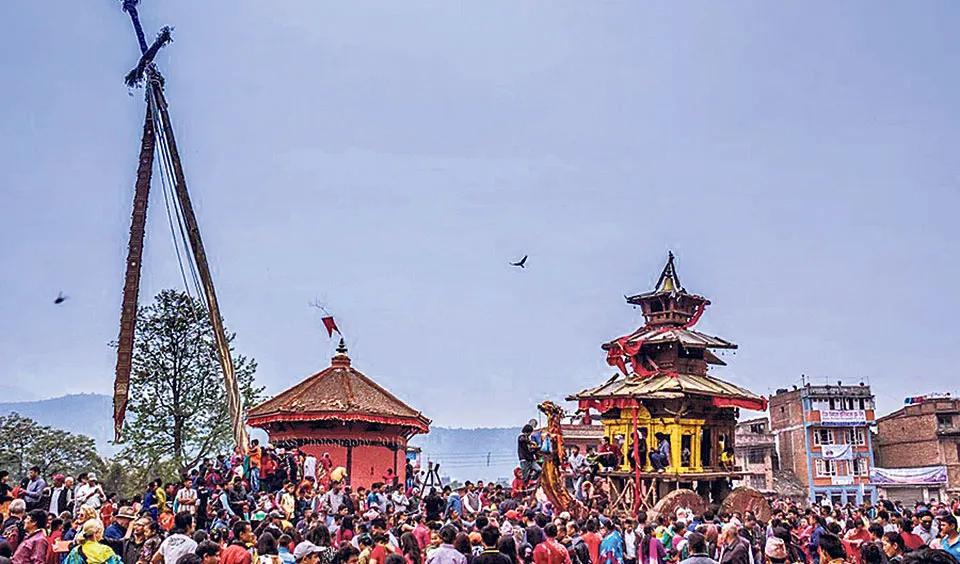
A tall wooden pole called Yosin is erected at Taumadhi Square in Bhaktapur. The pole is decorated with banners and represents the mythological serpent.
Days 2–4 — Chariot Processions
Two large wooden chariots — one for Bhairav and one for Bhadrakali — are pulled through the streets by hundreds of devotees. The chariots are massive, and pulling them is a community effort that often sparks friendly rivalry between neighborhoods.
Day 5 — Tongue-Piercing Festival
Some devotees pierce their tongues with long needles as an offering to Bhairav. This ritual is a test of endurance and devotion, and it draws large crowds.
Day 8 — Tug-of-War
The dramatic tug-of-war between the upper and lower halves of Bhaktapur takes place. The two sides pull on a giant rope attached to the Yosin pole. Whichever side wins is believed to have good fortune for the coming year.
Day 9 — Yosin Thanegu (Pole Lowering)
The Yosin pole is lowered and dragged through the streets to the river, where it is immersed. This marks the end of Bisket Jatra.
The Chariots of Bisket Jatra
The chariots of Bisket Jatra are among the largest in Nepal. Each is built from wood, decorated with carvings, and can weigh several tons. Pulling them requires hundreds of people working together.
The Bhairav chariot is particularly famous. It is said to be so heavy that the wooden wheels often sink into the ground during the procession.
Bhaktapur: The City of Festivals
Bhaktapur (also called Bhadgaon) is known as Nepal’s city of festivals. It was the capital of a Malla kingdom and has preserved its medieval character better than Kathmandu or Patan.
The city is famous for:
- Bhaktapur Durbar Square: A UNESCO World Heritage Site with palaces and temples.
- Pottery Square: Where traditional clay pottery is still made by hand.
- Newar culture: Bhaktapur is one of the best places to experience Newar traditions, food, and festivals.
Bisket Jatra in Modern Nepal
Bisket Jatra remains a major event in Bhaktapur, drawing thousands of visitors from Kathmandu and abroad. The festival is a UNESCO-recognized intangible cultural heritage and a highlight of Nepal’s festival calendar.
In recent years, the festival has been promoted as a tourist attraction, with visitors coming to see the chariots, the tug-of-war, and the tongue-piercing ritual.
Frequently Asked Questions
What is Bisket Jatra?
Bisket Jatra is a nine-day Newar festival in Bhaktapur celebrating the Nepali New Year. It features chariot processions, a tug-of-war, and the raising of a Yosin pole.
When is Bisket Jatra celebrated?
Bisket Jatra is celebrated in mid-April, usually starting four days before the Nepali New Year (Baisakh 1) and ending a few days after.
What does “Bisket” mean?
“Bisket” comes from the Nepali words “Bi” (snake) and “Syako” (slain), referring to the legend of the prince who killed the serpents to free the princess.
What happens during the Bisket Jatra tug-of-war?
The upper and lower halves of Bhaktapur pull on a giant rope attached to the Yosin pole. Whichever side wins is believed to have good fortune for the coming year.
Read next: Explore the Festivals hub for all festival articles, or dive into Nepal’s History to understand the origins of these traditions.
Related districts: Bhaktapur, Kathmandu, Lalitpur, Kavrepalanchok, Nuwakot