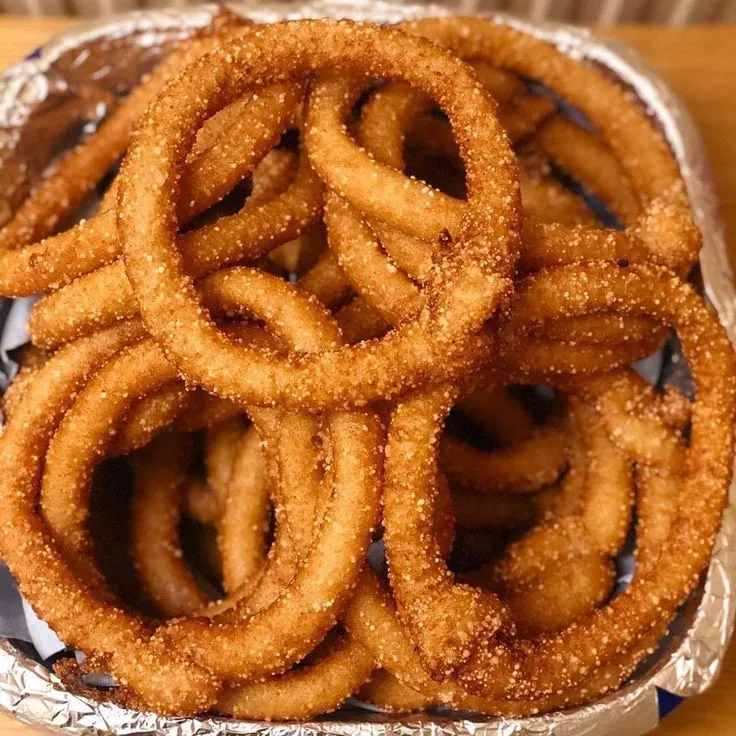
Sel Roti (सेल रोटी) is one of Nepal’s most distinctive foods — a ring-shaped, deep-fried bread made from rice flour, with a crispy exterior and a soft, slightly sweet interior. It’s the signature festival food of Dashain and Tihar, and it appears at weddings, religious ceremonies, and family gatherings across the country.
Unlike most breads, Sel Roti is made from rice flour, not wheat. It has no yeast, no baking powder — just rice flour, water, sugar, and sometimes ghee or milk. It’s shaped by hand and fried in a ring, giving it its iconic doughnut-like form.
What Is Sel Roti?
Sel Roti is a Nepali rice bread with the following features:
- Made from rice flour: Finely ground rice, mixed with water to form a thick batter
- Ring-shaped: Poured into hot oil by hand in a circular motion
- Deep-fried: Cooked in oil until golden-brown and crispy
- Slightly sweet: Sweetened with sugar or ghee, but not overly sweet
- Crispy outside, soft inside: The signature texture
Sel Roti is eaten on its own, with yogurt, or with meat curries. It’s especially popular at festivals, where families make large batches to share with neighbors and relatives.
The Origin of Sel Roti
Sel Roti has been part of Nepali culture for centuries. Its exact origin is unclear, but it’s generally considered a Nepali invention rather than a dish borrowed from India or Tibet. Some food historians trace it to the Newar community of the Kathmandu Valley; others say it originated in the hills, where rice was the main grain.
What’s certain is that Sel Roti is uniquely Nepali — it’s not found in India or Tibet in the same form.
How Sel Roti Is Made
Making Sel Roti takes practice. The process:
- Soak the rice: Raw rice is soaked in water for several hours.
- Grind the rice: The soaked rice is ground into a fine flour or paste.
- Mix the batter: Rice flour is mixed with water, sugar, and sometimes ghee, milk, or cardamom to form a thick, pourable batter.
- Heat the oil: A deep pan of oil is heated over a fire.
- Shape and fry: A handful of batter is lifted and poured into the hot oil in a circular motion, forming a ring.
- Flip and fry: The Sel Roti is flipped once and fried until golden-brown on both sides.
- Drain and serve: The cooked Sel Roti is drained on paper and served hot or at room temperature.
The technique of shaping a ring in hot oil by hand is what makes Sel Roti distinct — and difficult to master.
When Sel Roti Is Eaten
Sel Roti is most associated with:
- Dashain: The 15-day festival, especially Vijaya Dashami
- Tihar: The five-day festival of lights
- Weddings: Served at Newar and other traditional weddings
- Bratabandha: Hindu sacred-thread ceremonies
- Festivals and fairs: Every Nepali fair has Sel Roti vendors
- Daily life: In many hill villages, Sel Roti is made for breakfast or an evening snack
Regional and Community Variations
Sel Roti is universal in Nepal, but there are regional differences:
- Newar community: Newar Sel Roti is often smaller and sweeter
- Hills (Pahad): Larger, denser, and served with yogurt or meat curry
- Terai: Sometimes made with a mix of rice and wheat flour
- Cities: Modern variations include Sel Roti with chocolate, cheese, or banana fillings
Sel Roti Today
Sel Roti remains one of Nepal’s most beloved foods. In Kathmandu, Sel Roti vendors set up stalls on street corners, especially during festivals. In villages, families still make Sel Roti at home during Dashain and Tihar.
Outside Nepal, Sel Roti is a symbol of Nepali identity — a taste of home for the diaspora, and a curiosity for food lovers. Nepali restaurants abroad often serve Sel Roti as a dessert or festival specialty.
Frequently Asked Questions
What is Sel Roti?
Sel Roti is a ring-shaped, deep-fried rice bread from Nepal. It has a crispy exterior and soft interior, and is a signature food of Dashain and Tihar.
What is Sel Roti made of?
Sel Roti is made from rice flour, water, sugar, and sometimes ghee or milk. It has no yeast or baking powder.
When is Sel Roti eaten?
Sel Roti is especially popular during Dashain and Tihar. It is also served at weddings, bratabandha ceremonies, and as a daily snack in many parts of Nepal.
Is Sel Roti sweet or savory?
Sel Roti is slightly sweet — it contains sugar and sometimes ghee, but it’s not as sweet as a dessert. It’s usually eaten on its own, with yogurt, or with meat curries.
Read next: Gundruk: The Fermented Greens of the Himalayas — Nepal’s traditional superfood, dried and fermented for winter.
Related districts: Kathmandu, Lalitpur, Bhaktapur, Sindhupalchok, Palpa