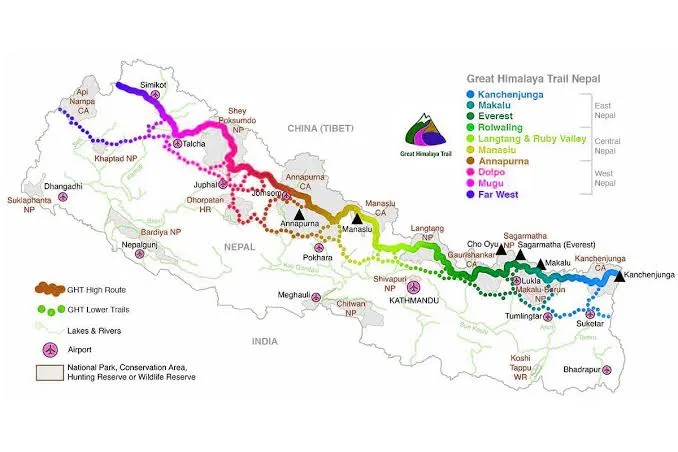
For most trekkers, the Everest Base Camp or Annapurna Circuit is the ultimate goal. But for a select few, there is a greater challenge: the Great Himalayan Trail (GHT).
The GHT is a network of trekking routes that spans the entire length of Nepal, from the far eastern border with India to the far western border. It is roughly 1,700 kilometers long and crosses some of the highest and most remote terrain on Earth.
What is the Great Himalayan Trail?
The GHT is not a single trail, but a series of interconnected paths. It is divided into two main routes:
- The High Route: This is for experienced, high-altitude trekkers. It stays high in the mountains, often above 4,000 meters, and crosses several high passes. It is extremely challenging and requires technical skills.
- The Low Route: This is a more accessible route that stays in the mid-hills and valleys, passing through villages and forests. It is less dangerous but still requires excellent fitness.
The GHT was formally launched in 2008 to promote sustainable tourism and spread the economic benefits of trekking to remote regions that had previously seen few visitors.
The Route
The GHT passes through some of Nepal’s most iconic regions:
- Kanchenjunga (East): The starting point, near the world’s third-highest mountain.
- Makalu Barun: A remote, pristine valley.
- Everest Region (Sagarmatha): The classic Everest trails, including Namche Bazaar.
- Rolwaling: A remote valley west of Everest.
- Langtang: Accessible from Kathmandu.
- Ganesh Himal: A region rarely visited by trekkers.
- Manaslu: The circuit around the world’s eighth-highest mountain.
- Annapurna: The classic Annapurna Circuit and Mustang.
- Dolpo: A restricted, remote area in the rain shadow of the Himalayas.
- Rara Lake: Nepal’s largest lake.
- Humla: The far north-western corner of Nepal.
- Api and Saipal (Far West): The final stretch to the western border.
How Long Does It Take?
The full GHT (High Route) takes about 150 days to complete. Most trekkers do it in sections:
- Section 1 (Kanchenjunga to Makalu): 30 days
- Section 2 (Everest to Rolwaling): 25 days
- Section 3 (Langtang to Manaslu): 30 days
- Section 4 (Annapurna to Dolpo): 30 days
- Section 5 (Rara to Humla): 25 days
- Section 6 (Humla to Far West): 10 days
Challenges
The GHT is not for beginners. The challenges include:
- Altitude: Many sections are above 4,000 meters for days at a time.
- Remoteness: Some sections are days away from the nearest road or village.
- Weather: Sudden snowstorms, high winds, and extreme cold are common.
- Logistics: Resupplying food and fuel is difficult in remote areas.
- Permits: Several sections (Dolpo, Mustang, Manaslu) require restricted area permits and a licensed guide.
Why Do It?
Despite the challenges, trekkers who complete the GHT describe it as a life-changing experience. You walk through pristine forests, remote Sherpa and Tibetan villages, and some of the most spectacular mountain scenery on Earth. It is a journey of self-discovery as much as a physical challenge.
How to Plan
If you are considering the GHT, plan for at least 6 months of preparation. You will need:
- Physical training: Long hikes, cardio, and strength training.
- Logistics: Detailed maps, permits, and resupply points.
- Guide: Highly recommended for the High Route, especially in restricted areas.
- Budget: $8,000–15,000 for the full route (including permits, food, and guides).
Frequently Asked Questions
What is the Great Himalayan Trail?
The GHT is a 1,700 km network of trekking routes that spans the entire length of Nepal, from Kanchenjunga in the east to the far west.
How long does it take to hike the GHT?
The full High Route takes about 150 days. Most trekkers do it in sections of 25–30 days.
Is the GHT harder than Everest Base Camp?
Yes, significantly. The GHT is much longer, more remote, and involves more altitude and technical challenges than EBC.
Do I need a guide for the GHT?
A guide is highly recommended for the High Route and required for restricted areas like Dolpo, Mustang, and Manaslu.
Read next: The National Parks of Nepal — Discover Nepal’s protected areas and their wildlife.
Related districts: Solukhumbu, Taplejung, Manang, Dolpa, Humla